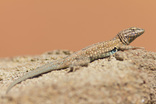
| Beth - "This was a great week for seeing Sceloporus tristichus. Celina and I surveyed a rocky canyon for a day where we must have seen 20 individuals between us. Plateau Lizards are usually quite skittish but the specimens I saw seemed just as curious about me as I was about them. Some were missing or re-growing tails, and some had typical bright orange lips. I was able to take great photos of them all because they were willing to stick around long enough (and come out from their hiding spots) so that I could adjust camera settings for better voucher photos. Maybe the quickest photos snapped this week were for a species I had not recorded yet this summer - the Western Terrestrial Garter Snake. Because it was a dead on a busier road, I only had time enough to snap two photos as vouchers, but it was worth pulling the car over for." | Celina - "When you're looking at a rattlesnake that is aware of you and rattling, you're probably not going to be focused on the grass behind it. As I picked my camera up to take a photo, I initially missed seeing a second prairie rattlesnake slithering out of the grass! When this second individual joined in the rattling and wrapped up with the first, I was shocked! The two turned into a single coil and the second had nosed over the first before returning its glare to me. The first never took its eyes off of me. This was something I wasn't expecting, so I was very surprised - and I'm glad I was able to get photos of the two together (see photos above)." |
|
0 Comments
Danny - "I'm always excited to get back to the state I grew up in, and Kansas provided great weather and opportunities to see reptiles this week. We detected 3 'new' species for the project on this trip - Massasauga, Eastern Hog-nosed Snake, and Diamond-backed Watersnake. We also documented a small range extension and new county record for Speckled Kingsnake!" Celina - "There are several species that we still haven't detected for the project, this week I considered myself incredibly lucky to detect a neonate Massasauga in a bison wallow while on a survey! This small rattlesnake species has eluded us despite having several sites where the folks who manage and work the area say (and have shown us photos!) Massasaugas are there - we were in luck this trip and detected a total of 9 individuals, ranging from neonates to large adults." Devin - "This week, Beth and I surveyed some new areas in Wyoming and western Nebraska. A few days before the start of our surveys, this area experienced a bout of cold weather and even a brief flurry of snow! We were therefore not anticipating to see much herp activity, believing the majority of reptiles would be beginning to hibernate at that point. We were pleasantly surprised when our surveys yielded a decent number of snakes! We found the sheds of a few different species, and I also found two Prairie Rattlesnakes, a Common Gartersnake, and a Racer!" Beth - "Surveying in more aquatic and marshy habitat types this week resulted in the observation of a new species. Colder weather in Wyoming the week before meant we saw mostly snakes - Devin and I spotted a Common Gartersnake in the road. This specimen was probably the largest Gartersnake I have ever come across. Unfortunately, it was dead. I did make an exciting observation this week in Fort Collins over the weekend (on a day off)! In one of the city parks, a snake as small as worm slithered from the grass onto a concrete pathway when I walked by. It curled up and I got a look at the maroon and grey saddles that ran down its back. I remembered that some species have a pattern when they are younger and it becomes less distinct as they age and this was the case for the small North American Racer at my feet. Without a GPS that Saturday, I used the Great Plains Reptile Monitoring mobile app on my phone to document it."
Beth - "Throughout the course of the summer we have seen a few crickets skewered on the prongs of barbed wire fences and recognized them as the work of a shrike. Before surveying some of our sites this week, we heard from landowners that Lesser Earless and Fence Lizards were being pierced on the barbed wire. I kept this in mind while we looked for what reptiles we could find in the cool weather. Then, as Devin and I were traveling from one site to another, I hopped out of our truck to open a gate. Next to the gate entrance was the head and neck of a small snake. Thoroughly confused, I waved for Devin to come take a look and he was just as surprised to see the head of this little snake on a gate we had gone through earlier not more than a few hours previously. Devin turned around and looked at the rest of the gate only to find the rest of the slim body stuck to another barb (see photos above). Remembering what we had heard about the lizards earlier, we concluded it must have been the work of a shrike. It took us a few minutes and some paging through a field guide to finally agree that the little snake was actually a juvenile Coachwhip (neither of us had ever seen the juvenile patterning of a Coachwhip). Often making appearances for split seconds on the road, we usually only see Coachwhips as adults so it was fascinating to see a juvenile stuck by a shrike on that gate!"
The remaining crew spent the week in Fremont and Pueblo Counties, Colorado, during what is likely to be one of the last weeks some of the real heat-loving reptile species are active before entering hibernation. We expect to continue to see species including Prairie Rattlesnakes and Short-horned Lizards for at least 3 or 4 more weeks, but the prediction is that this winter is supposed to arrive early and temperatures are predicted to be much colder this year relative to last year...
|
Archives
May 2015
CSU Reptile Monitoring ProjectWeekly observations & comments from the field crew and volunteers! |
 RSS Feed